
Skillet Pork-Napa Cabbage Gyoza (Crispy-Bottom Dumplings)
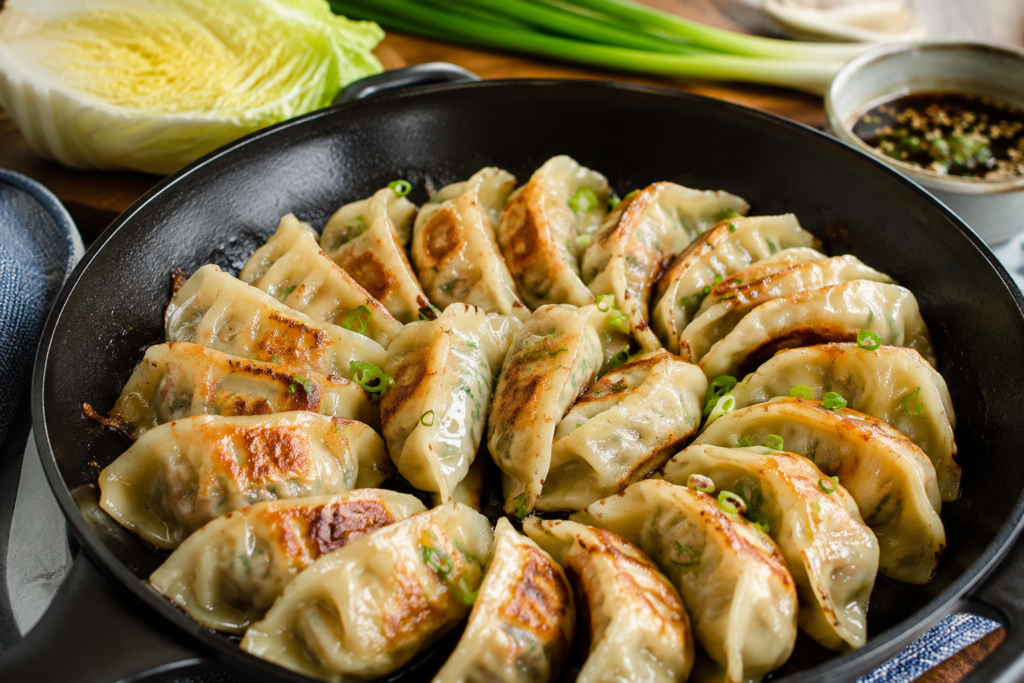
When searching for a authentic cabbage dumplings recipe, many home cooks get confused by the endless variations online. “Cabbage dumplings” serves as an umbrella term rather than a single canonical dish. Northern Chinese jiaozi use finely chopped Napa cabbage inside flour wrappers, Japanese gyoza feature thinner skins with a garlic-forward pork filling, Polish pierogi and Ukrainian varenyky rely on hearty doughs filled with sauerkraut or potatoes, and Chinese cabbage rolls ditch flour wrappers entirely to wrap filling in whole leaves.
EARLY HINT — If you want the ultimate crispy bottom without wrapper tearing, use thin, commercial round gyoza wrappers kept damp under a towel while folding.
Few kitchen moments are as disappointing as biting into a dumpling expecting a shattering, golden crunch, only to get a soggy, waterlogged wrapper. The culprit isn’t your pan or your stovetop heat; it’s the hidden moisture trapped inside raw cabbage.
The Science of Moisture Control in Dumplings
Cabbage is made of over 90% water. When raw, un-salted cabbage is sealed inside a flour wrapper and heated, that water releases as steam directly into your filling, turning the inside wet and leaking out to ruin your crispy bottom crust.
To fix this, salt the finely chopped Napa cabbage with kosher salt and let it rest for 10–15 minutes. The salt draws out intracellular moisture through osmosis. Transferring the cabbage to a clean kitchen towel and wringing it firmly yields a dramatic reduction in weight and volume, leaving behind crisp vegetable strands that won’t weep inside the wrapper.
| Step / Ingredient | Moisture Fix | Purpose |
| Napa Cabbage | Salt 10-15 min & wring in towel | Prevents soggy wrappers & loose filling |
| Shiitake Caps | Dry-cook 3-4 min over medium heat | Evaporates surface water before mixing |
| Ground Pork | Knead 2-3 min in one direction | Emulsifies protein to trap remaining juices |
According to the official USDA Food Safety Guidelines, raw ground meat preparations must reach precise internal temperature thresholds to be completely safe to consume. Vigorous kneading makes the ground pork cohesive and tacky, allowing it to hold onto the seasonings while trapping just enough natural juice during the quick steam cycle.
Disclosure:-This post contains general culinary and safety guidelines; ensure pork products are cooked to USDA food safety standards.
What Doesn’t Work (Common Mistakes)
- Skipping the Cabbage Wringing: Adding raw, unsalted cabbage straight into ground meat creates a watery slurry that breaks thin flour skins during folding.
- Overcrowding or Over-Flooding the Skillet: Pouring too much water into the pan steams the entire wrapper into mush instead of crisping the bottom.
- Guessing Meat Doneness by Shell Color: Relying on wrapper browning alone to assume the inside is cooked. Ground pork must reach 160∘F(71 ∘ C) internally.
- Leaving Wrappers Exposed: Gyoza wrappers dry out and crack rapidly in open air; keep them covered with a damp towel or refrigerated until sealed.
The Ingredients & Preparation
Cabbage & Filling
- 300 g (10.6 oz) trimmed Napa cabbage, finely chopped
- 1¼ tsp kosher salt (for drawing moisture; discarded with liquid)
- 450 g (1 lb) raw ground pork
- 100 g (3.5 oz) fresh shiitake mushrooms, stems removed, caps finely chopped
- 50 g (1.8 oz) scallions, finely minced
- 15 g (1 tbsp) fresh ginger, finely grated
- 12 g (1 tbsp) garlic, finely minced
- 30 g (2 tbsp) regular soy sauce
- 14 g (1 tbsp) sesame oil, divided between cooking batches
- 1 tsp ground white pepper
- 2 tsp granulated sugar
Wrappers & Steaming
- 32 thin, round gyoza wrappers
- 2 tbsp water (1 tbsp per batch)
How to Make Skillet Pork-Napa Cabbage Gyoza
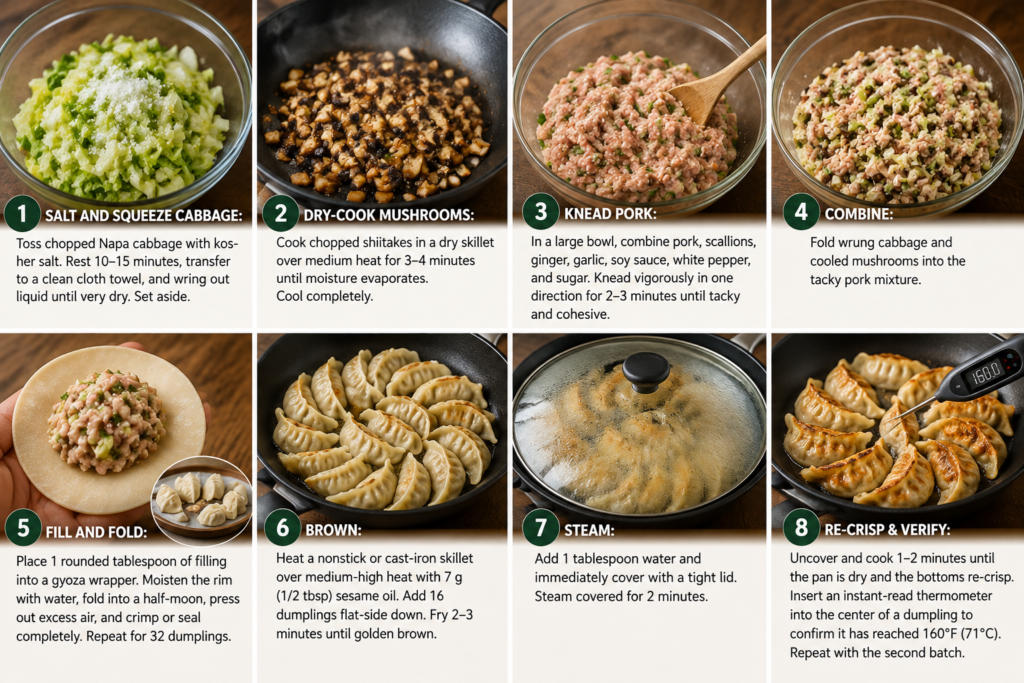
- Salt and Squeeze Cabbage: Toss chopped Napa cabbage with kosher salt. Rest 10–15 minutes, transfer to a clean cloth towel, and wring out liquid until very dry. Set aside.
- Dry-Cook Mushrooms: Cook chopped shiitakes in a dry skillet over medium heat for 3–4 minutes until moisture evaporates. Cool completely.
- Knead Pork: In a large bowl, combine pork, scallions, ginger, garlic, soy sauce, white pepper, and sugar. Knead vigorously in one direction for 2–3 minutes until tacky and cohesive.
- Combine: Fold wrung cabbage and cooled mushrooms into the tacky pork mixture.
- Fill and Fold: Place 1 rounded tablespoon of filling into a gyoza wrapper. Moisten the rim with water, fold into a half-moon, press out excess air, and crimp or seal completely. Repeat for 32 dumplings.
- Brown: Heat a nonstick or cast-iron skillet over medium-high heat with 7 g (1/2 tbsp) sesame oil. Add 16 dumplings flat-side down. Fry 2–3 minutes until golden brown.
- Steam: Add 1 tablespoon water and immediately cover with a tight lid. Steam covered for 2 minutes.
- Re-Crisp & Verify: Uncover and cook 1–2 minutes until the pan is dry and the bottoms re-crisp. Insert an instant-read thermometer into the center of a dumpling to confirm it has reached 160∘F(71 ∘ C). Repeat with the second batch.
| Total Yield | 32 dumplings | 4 Servings (8 per person) |
| Prep / Cook Time | 45 min prep / 14 min cook | ~60 minutes total |
| Skillet Heat & Oil | Medium-high; 7 g sesame oil/batch | Golden, crisp flat bottoms |
| Safety Endpoint | Internal temperature probe | 160∘F(71 ∘ C) minimum |
Estimated Nutrition per Serving
Nutrition figures are calculated estimates based on raw ingredient weights and standard gyoza wrapper labels (4 servings, 8 dumplings per serving). They are not laboratory analyses.
- Calories: 515 kcal
- Protein: 30 g
- Total Fat: 26 g (Saturated Fat: 8 g)
- Carbohydrates: 41 g (Dietary Fiber: 3 g)
- Sodium: 670 mg
Realistic Cooking Timeline
- Week 1 (First Attempt): Mastering the salting technique and fold tightness. Focus on keeping excess air out of the half-moon seals so wrappers don’t burst in steam.
- Week 2 (Batch Adjustments): Dialing in stovetop heat levels so the bottoms brown in 2–3 minutes without burning before the water is added.
- Week 4 (Efficiency & Freezing): Folding a double batch in under 30 minutes and freezing raw dumplings for quick weeknight skillet meals.
Frequently Asked Questions
Do you need to salt cabbage for dumplings? Yes. Salting Napa cabbage draws out water that would otherwise leak during cooking, turning the filling loose and making the wrapper bottoms soggy.
Can cabbage dumplings be frozen before cooking? Yes. Freeze raw assembled dumplings in a single layer on a parchment-lined baking sheet until solid, then transfer to an airtight bag. Cook straight from frozen, adding an extra minute to the steaming phase, and verify the pork center reaches 160∘F(71 ∘ C).
How do you get crispy bottoms on gyoza? Use the fry-steam-re-crisp method: brown the flat bottoms in oil first, add a splash of water and cover to steam the top wrapper, then uncover during the last minute to evaporate remaining moisture and restore bottom crispness.
Tonight’s Action Plan
To make tonight’s dumpling prep seamless, chop and salt your Napa cabbage first before measuring out any other ingredients. While the salt draws out moisture over 15 minutes, grate your ginger, mince the garlic, and dry-cook your shiitake caps. By organizing the moisture-reduction step early, your filling will assemble easily, seal cleanly, and yield perfectly crispy skillet gyoza.