
3 Signs Your Hair Loss After 40 Is Actually Hormonal

More strands in your hairbrush, a ponytail that needs an extra wrap, a center part that looks wider in the mirror — these small changes are easy to dismiss individually. But together, they often point to one specific cause: hormonal hair thinning. Here are the 3 clearest signs to watch for, and what’s actually driving them.
Skin & Scalp Truth If your hair density seems to disappear over the crown while your hairline remains intact, the problem is not your shampoo—it is an internal shift in your estrogen-to-androgen ratio altering your hair growth cycle.
It is easy to blame a hectic schedule, a new styling product, or recent life stress, but when hair density gradually fades across the top of your head, the root cause is often deep within your endocrine system. That silent realization—that your body is shifting underneath the surface—can bring a quiet surge of frustration and self-doubt. Decades of using the same hair routines suddenly feel ineffective, leaving you wondering if you did something wrong. Here is the truth: you did not cause this. Hormonal shifts during perimenopause and menopause alter how your hair follicles grow, and understanding this biological transition is the first step toward reclaiming control.
What Is Female Pattern Hair Loss After 40?

Unlike male pattern baldness, which often presents as a receding hairline or a completely bald spot on the crown, hormonal hair loss after 40 in women follows a distinctly diffuse pattern.
According to medical clinical data published by the Cleveland Clinic, female pattern hair loss affects approximately 30 million women in the United States. It is clinically defined as a non-scarring, non-inflammatory condition characterized by a gradual loss of hair density over the crown and mid-frontal scalp, while preserving the frontal hairline.
Did You Know? Normal daily hair shedding ranges from 50 to 100 hairs. Hair loss becomes clinically defined when daily shedding consistently exceeds 125 hairs due to disrupted growth cycles.
Here are the three primary signs that your hair loss is rooted in hormonal shifts:
- A Widening Center Part: You notice more scalp showing right along your natural part line, creating a see-through appearance when styled.
- Decreased Ponytail Volume: Your hair feels lighter, thinner, and lacks its former bounce or thickness when gathered together.
- Diffuse Thinning Across the Crown: Rather than losing hair in patches, density drops evenly across the top and mid-frontal areas of your scalp.
The Science: Estrogen Decline and DHT Sensitivity
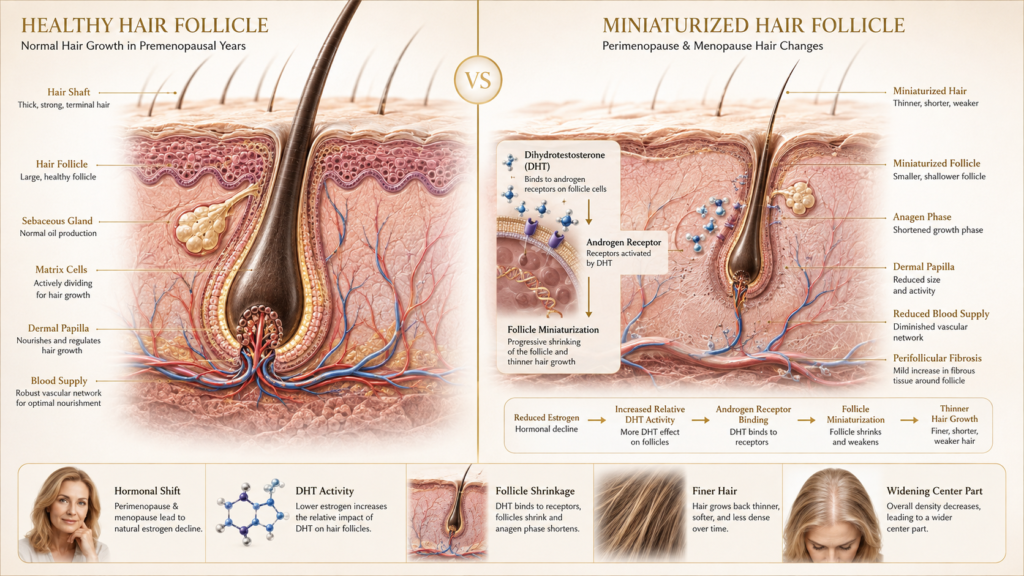
To understand why your hair changes after 40, you have to look at the hair growth cycle. Normally, your hair moves through three phases: anagen (growth phase lasting 2–7 years), catagen (transition phase lasting ~3 weeks), and telogen (resting phase lasting ~3 months).
| Anagen (Growth) | 2–7 Years | Phase shortens rapidly due to declining estradiol levels. |
| Catagen (Transition) | ~3 Weeks | Transition phase remains short and unchanged. |
| Telogen (Resting) | ~3 Months | Gap between shedding and new growth lengthens significantly. |
During perimenopause and menopause, estradiol drops rapidly. Estrogen normally prolongs the anagen growth phase and augments crucial growth factors. When estrogen declines, the androgen-to-estrogen ratio shifts, creating relative androgen dominance. Enzymes convert trace androgens into dihydrotestosterone (DHT), which binds strongly to receptors in your hair follicles. This triggers follicular miniaturization—a process where thick terminal hairs are progressively replaced by fine, short vellus hairs.
Biggest Mistake Buying expensive volumizing shampoos or hair-thickening oils will not stop follicular miniaturization. Topical cleansers cannot alter the internal hormonal binding of DHT at the hair root.
Here are common practices that fail to resolve hormonal thinning:
What Doesn’t Work for Hormonal Hair Loss
When hair starts thinning, it is tempting to throw every trending shampoo or scalp scrub at the issue. However, treating hormonal shifts with surface-level fixes usually leads to disappointment.
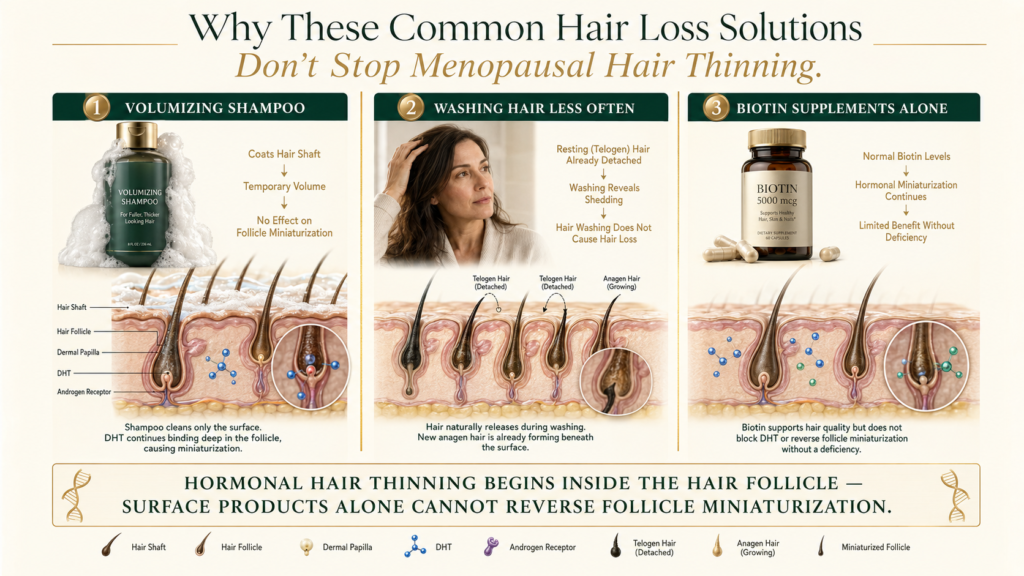
- Volumizing Shampoos: While they temporarily coat the hair shaft to make it look fuller, they cannot penetrate the scalp to reverse miniaturization.
- Washing Hair Less Frequently: Washing less often does not stop shedding; hairs that fall out during washing were already detached and sitting in the resting phase.
3.Biotin Supplements Alone: Unless you have a clinically diagnosed biotin deficiency, taking high doses will not reverse estrogen-driven follicle miniaturization.
Clinical Severity Stages (Ludwig & Sinclair Scales)
Dermatologists use standardized grading systems to evaluate the progression of female pattern hair loss and guide clinical treatment.
| Ludwig Scale | Type I | Minimal thinning over the crown that can still be camouflaged with styling. |
| Ludwig Scale | Type II | Decreased overall volume and noticeable widening of the mid-line part. |
| Ludwig Scale | Type III | Diffuse thinning with a clear see-through appearance on top of the scalp. |
| Sinclair Scale | Stage 1–2 | Normal hair density to minimal rarefaction and slight widening of the central part. |
| Sinclair Scale | Stage 3–5 | Noticeable thinning, widening part line, and advanced density loss toward the front. |
Even in advanced stages of female pattern hair loss, the affected scalp area rarely becomes completely bald, unlike male pattern alopecia.
Realistic Timeline for Results
Reversing hair follicle miniaturization requires patience because the hair growth cycle moves slowly. Expecting overnight changes will only add unnecessary cortisol stress.
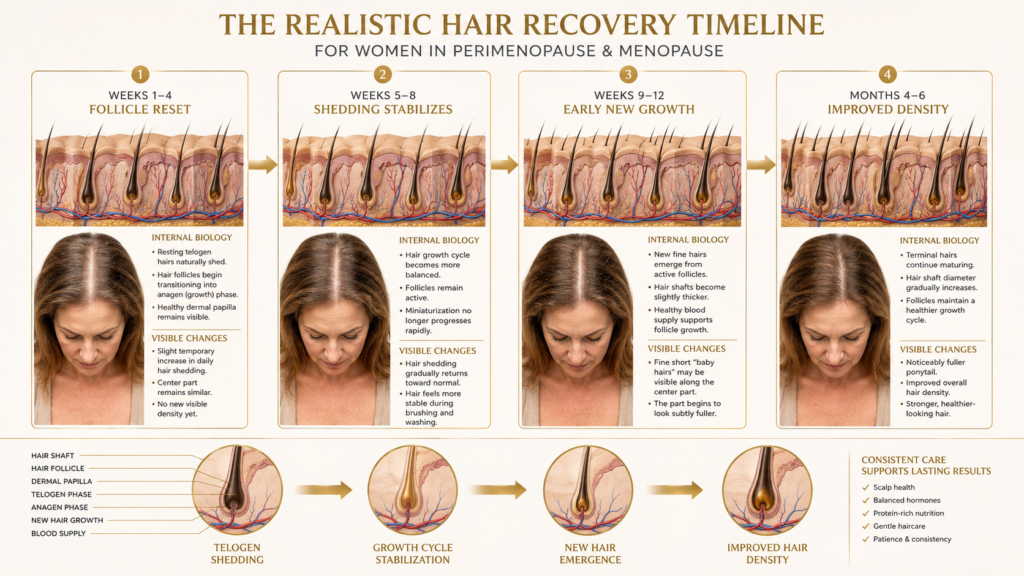
| Timeline | Expected Clinical Progress |
| Weeks 1–4 | Temporary shedding may occur as resting telogen hairs clear out. |
| Weeks 5–8 | Hair shedding begins to stabilize and return toward normal levels. |
| Weeks 9–12 | Fine, short vellus hairs begin emerging along the center part line. |
| Months 4–6 | Measurable increase in hair strand diameter and overall ponytail volume. |
Your hair will not regain its 20-year-old density overnight. What targeted intervention will do is halt further loss, protect remaining strands, and gradually restore healthy, visible scalp coverage.
Frequently Asked Questions
Myth vs Fact
Myth: Wearing hats or tying your hair up causes permanent menopausal hair loss.
Fact: External friction does not cause female pattern hair loss; FPHL is driven by internal genetics, androgen ratios, and estrogen drops.
How can I tell if my hair loss is hormonal versus a nutritional deficiency?
Hormonal hair loss presents as a slow, gradual widening of your center part and diffuse thinning over the crown. Nutritional deficiencies (like low iron or vitamin D) typically cause sudden, heavy shedding evenly across the entire scalp. A dermatologist can perform blood tests checking ferritin, thyroid function, and hormone panels to confirm.
Will my hair grow back naturally after menopause ends?
Complete restoration to pre-menopausal thickness rarely happens without active intervention. However, medical treatments such as topical minoxidil or prescription oral anti-androgens can halt progression and stimulate dormant follicles to regrow.
Does daily stress make my hormonal hair thinning worse?
Yes. Physical or emotional stress elevates cortisol levels, which can prematurely push active hair follicles out of the growth phase and into the resting phase. This creates temporary shedding on top of underlying hormonal thinning.
What to Do Tonight
If you are feeling overwhelmed by changing hair density, do not try to overhaul your entire wellness routine at once. Save This Action Examine your part line under clear light and take a baseline photo. Having an accurate record removes emotional guesswork over the coming months as you consult a professional. Tonight, start with one simple step: take that baseline photo under consistent lighting. Pair that with a gentle two-minute scalp massage using your fingertips to promote micro-circulation before bed. By understanding the internal biology of hormonal hair loss after 40, you replace anxiety with a clear, calm strategy for long-term scalp health.
Explore More Articles on Hair Care Over 40:-