
The Complete Guide to Hair Thinning After 40

Hair thinning after 40 isn’t random — it follows a predictable pattern rooted in declining estrogen and progesterone, which shortens your hair’s growth phase and lets androgens take over. The result is follicular miniaturization: thick strands gradually turning fine and wispy, especially at the crown and part line. This guide walks through why it happens and how to approach care from every angle — from spotting the signs to fixing routine mistakes to choosing the right treatments.
If you are looking for immediate topical management, standard clinical protocols often start with daily application of topical minoxidil. You step into the shower, run your fingers through your hair to rinse out conditioner, and suddenly stare at a clump in the drain that feels significantly larger than usual. Or maybe you’re sitting in car mirror light, catching a glimpse of your scalp showing through at the crown where a lush ponytail used to sit. It is unsettling to realize the products, shampoos, and styling routines you have relied on for twenty years suddenly seem to leave your hair looking flat, brittle, or dry. You didn’t change your routine, yet your hair texture feels completely different overnight.
The Hormonal Connection Behind Hair Thinning in Women Over 40
Menopause is clinically defined as the permanent cessation of menses for 12 consecutive months due to ovarian follicle depletion and systemic estrogen deficiency. During perimenopause and menopause, declining estrogen removes a natural shield from your hair follicles. Estrogen normally prolongs the anagen (growth) phase of the hair cycle. As it drops, follicles transition prematurely into the telogen (resting) phase, leading to accelerated shedding.
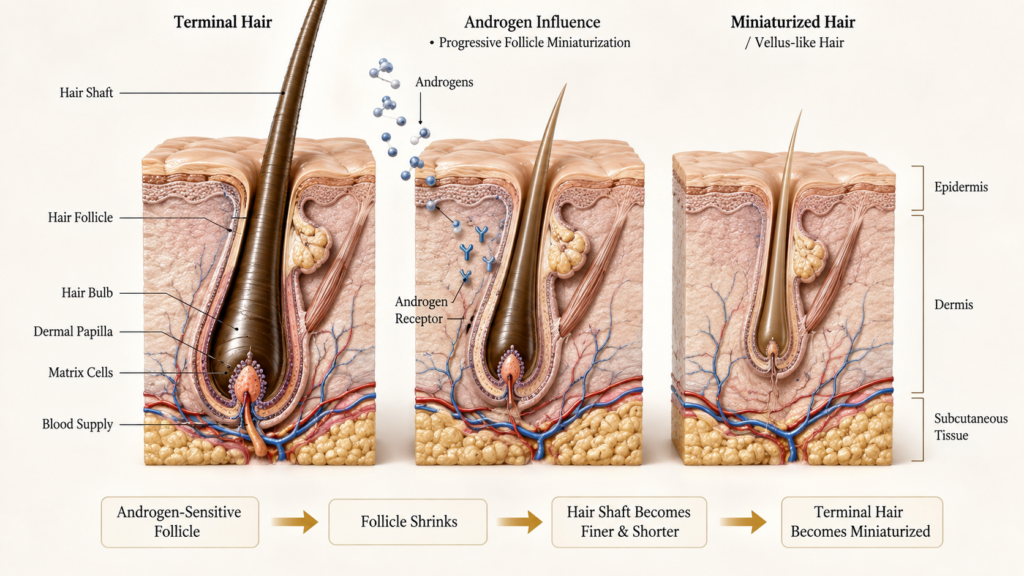
What is Follicular Miniaturization? A biological process where sensitive hair follicles shrink under androgen influence, replacing thick, pigmented “terminal” hairs with fine, short, unpigmented “vellus” strands.
Furthermore, as estrogen and progesterone plummet, systemic androgens become relatively dominant. According to research published by the American Academy of Dermatology (AAD), the enzyme 5-alpha reductase converts circulating testosterone into Dihydrotestosterone (DHT). DHT binds to receptors in susceptible follicles, triggering miniaturization. Recent clinical studies highlight that the downregulation of the catenin signaling pathway further impairs follicle regeneration during midlife.
| Factor | Pre-Menopause Mechanism | Menopausal Shift Mechanism |
| Estrogen Levels | High; extends active anagen growth phase. | Drops rapidly; forces follicles into telogen resting phase. |
| Androgen Balance | Counterbalanced by protective estrogens. | Relative dominance; DHT drives follicular miniaturization. |
| Microcirculation | Robust capillary delivery to dermal papilla. | Reduced blood flow, limiting follicular oxygen and nutrients. |
| Wnt/β-catenin Pathway | Active signal driving follicular renewal. | Downregulated; impairs hair follicle niche regeneration. |
Common Missteps That Fail to Fix Hair Thinning Over 40
When sudden hair shedding starts, standard instinct pushes us toward aggressive cosmetic quick-fixes. Unfortunately, many popular strategies fail to address midlife hair changes:

- Relying solely on high-dose Biotin: Biotin supplements only improve hair structure if an actual systemic biotin deficiency exists. For hormonal thinning, biotin does not address DHT activity or estrogen decline.
- Switching to harsh clarifyers: Using heavy clarifying shampoos to clean the scalp often strips essential lipids, worsening structural dryness and brittleness.
- Piling on heavy butter masks: Deep conditioners coat the hair shaft for temporary smoothness, but they cannot penetrate or revive a miniaturizing dermal papilla.
- Ignoring underlying blood markers: Overlooking internal deficiencies like low ferritin or Vitamin D while spending heavily on external serums delays true structural support.
Clinical Diagnostic Stages: The Ludwig Scale
Unlike male pattern baldness, which often presents as a receding hairline or total crown hair loss, hair thinning in women over 40 usually manifests as diffuse thinning across the top of the scalp while preserving the frontal hairline.
| Ludwig Stage | Clinical Presentation | Primary Management Focus |
| Stage I | Subtle thinning along the crown and initial widening of the center part. | Early intervention, anti-androgen balance, nutritional optimization. |
| Stage II | Marked density drop; scalp clearly visible through a widened part line. | Daily Minoxidil, targeted microcirculation therapies, laser treatments. |
| Stage III | Extensive hair loss across the entire crown with compromised density. | Aggressive clinical management, combined medical and systemic therapies. |
Realistic Timeline for Regrowth and Stabilization
Hair grows in slow, deliberate cycles, making patience essential when starting any clinical intervention.
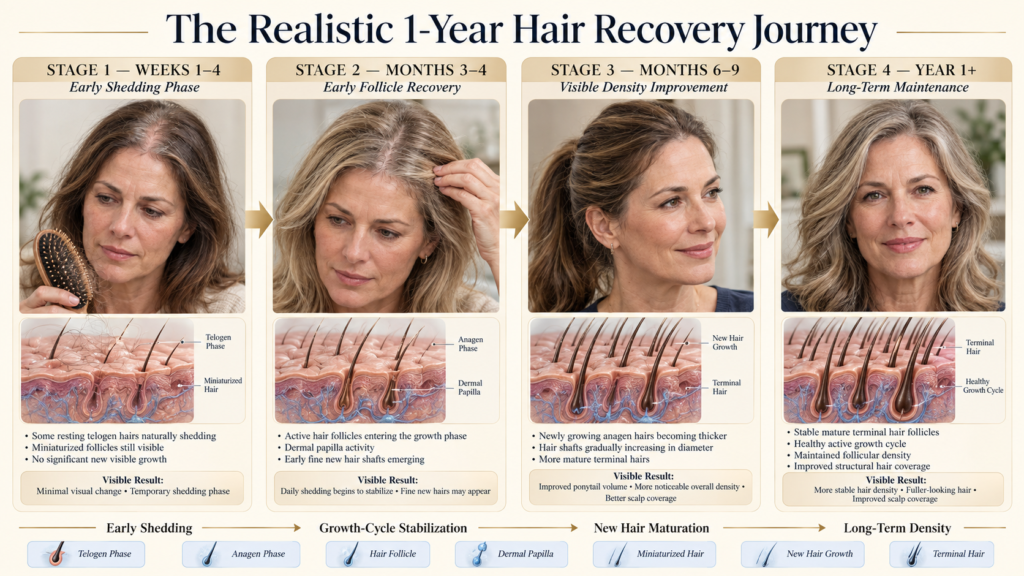
| Timeline | What Is Happening Biologically | Expected Visual Result |
| Weeks 1–4 | Early telogen shedding may briefly increase as miniaturized hairs push out. | Minimal visual change; temporary shedding phase. |
| Months 3–4 | Follicular stem cell reactivation and dermal papilla stimulation. | Stabilization of daily shedding; fine baby hairs along part. |
| Months 6–9 | Newly awakened anagen hairs thicken into pigmented terminal shafts. | Improved overall ponytail volume and narrower center part. |
| Year 1+ | Long-term maintenance of stabilized follicular density. | Re-established structural hair density and improved scalp coverage. |
Frequently Asked Questions
Can hair loss from menopause be reversed?
While restoring 100% of youthful density is rare, early clinical intervention can halt active thinning and typically helps women regain 20% to 30% of lost hair density.
How do I know if my hair loss is hormonal or stress-related?
Hormonal loss presents gradually over months as a widening part line (female pattern hair loss). Stress-induced loss (telogen effluvium) usually causes abrupt, excessive daily shedding 2 to 3 months after a acute physical or emotional stressor.
Action Plan for Tonight
- Switch to gentle drying: Skip high-heat blow drying; let your hair air-dry to roughly 75% before using cool or low heat settings.
- Incorporate scalp massage: Spend 4 minutes tonight gently massaging your scalp using soft fingertip pads to support microcirculation to the dermal papilla.
- Audit your hair care regimen: Check your current shampoo and conditioner to ensure they are free of harsh sulfates that strip natural scalp lipids.
- Schedule a targeted lab panel: Make an appointment with your healthcare provider to test your Ferritin, Vitamin D, and thyroid levels.
Explore More Articles on Hair Care Over 40:-